605-225-4028
Injection Mold Tooling – Training Overview
This training provides a practical, shop-floor-to-engineering overview of injection mold tooling, using the referenced mold stack image as a visual guide. It is intended for engineers, toolmakers, technicians, and operators who interact with molds across design, build, maintenance, and production.
1. Purpose of an Injection Mold
An injection mold is a precision mechanical system designed to: Shape molten plastic into repeatable parts, Control cooling and solidification, Release the part consistently and safely, Withstand high pressure, heat, and cycle counts. A mold is typically mounted into an injection molding machine and cycles thousands to millions of times over its life.
2. Mold Orientation & Terminology
Molds are typically divided into two main halves:
A-Side (Cavity Side / Fixed Side)
Mounted to the stationary platen of the molding machine. This side typically forms the cosmetic or show surface of the part.
B-Side (Core Side / Moving Side)
Mounted to the moving platen. This side contains the ejector system and forms internal features of the part.
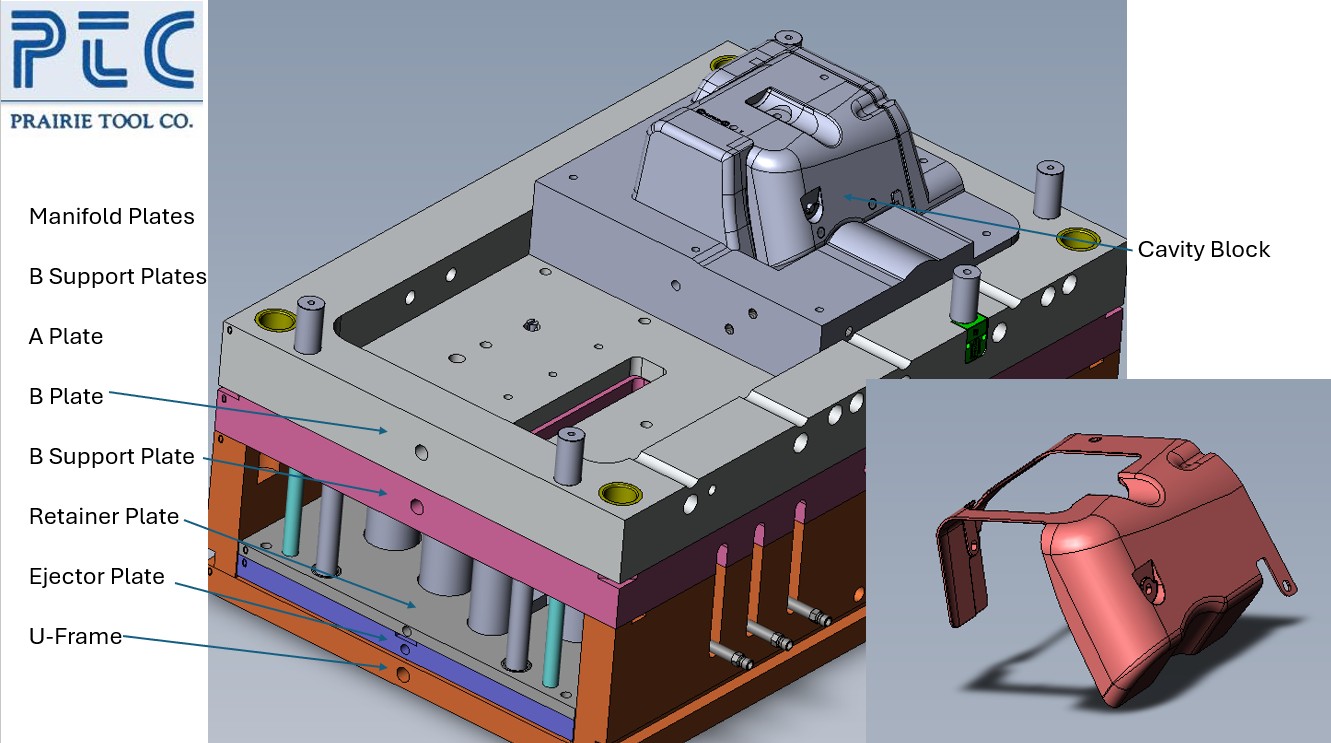
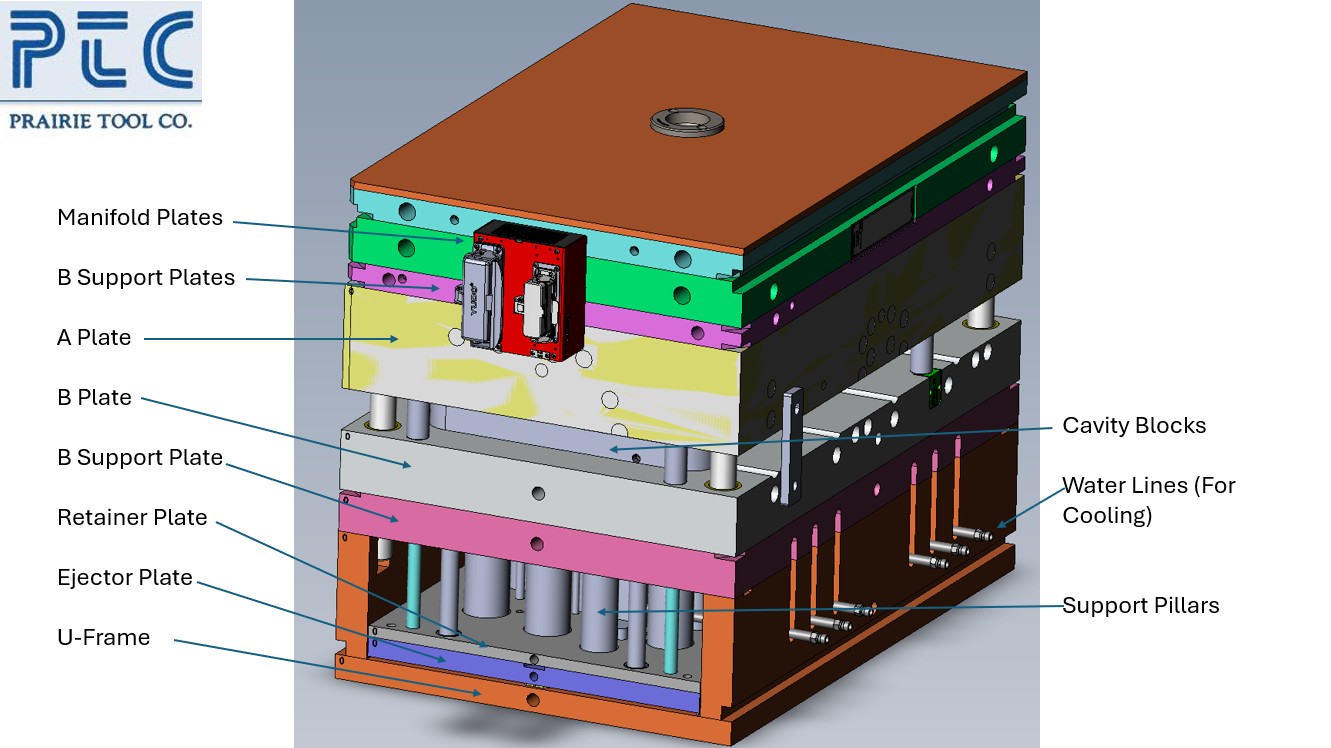
The photo shows a standard two-plate mold with an ejector system, commonly used across medical, consumer, and industrial applications.
3. Mold Stack Components (Top to Bottom)
Top Clamping Plate: Interfaces with the molding machine platen, Transfers clamp force evenly into the mold stack, Often includes a locating ring for nozzle alignment
Manifold Plates (Hot Runner System): Distribute molten plastic from the machine nozzle to each cavity, Maintain consistent melt temperature, Reduce runner waste and improve cycle time
3.3 A Plate (Cavity Plate): Contains the cavity blocks that define the exterior of the part, Cosmetic surfaces are machined here, Often hardened steel for wear resistance.
Design Considerations: Steel selection (H13, S7, stainless, etc.), Surface finish and texture, Venting to allow trapped air to escape
3.4 B Plate (Core Plate): Contains the core blocks that form internal part features, Houses core pins, lifters, and slides (if applicable)
3.5 Support Plates (A & B Support Plates): Provide structural rigidity, Prevent plate deflection under injection pressure, Protect tooling alignment and cavity integrity
3.6 Water Lines (Cooling System): Embedded cooling channels regulate mold temperature, Critical for cycle time, part quality, and dimensional stability
3.7 Support Pillars: Transfer clamp force through the mold stack, Prevent bowing or crushing of plates, Must be precisely sized and hardened
3.8 Retainer Plate: Holds ejector pins and components in position, Allows controlled movement during ejection
3.9 Ejector Plate: Actuated by the molding machine ejector system, Pushes ejector pins forward to release the molded part
Common Ejection Methods: Ejector pins, Sleeves, Stripper plates, Air assist
3.10 U-Frame / Mold Base: Structural foundation of the mold, Houses ejector system and return pins, Interfaces with machine ejector rods
4. Mold Operation Cycle
- Mold closes under clamp force
- Plastic is injected through nozzle and manifold
- Cavities fill and pack
- Cooling occurs through water lines
- Mold opens
- Ejector system activates
- Part is released
- Mold resets for next cycle